YoloSol presents
Good Fire, Living Water: The Gifts of a Marsh Economy
September 20-November 13, 2026
Davis Arts Center

A public exhibition on wetland stewardship featuring the eco-cultural and artistic practice of Wintun/Maidu culture-bearer Diana Almendariz and her daughters Ooti Maxine and Christina Almendariz. The multimedia exhibit also highlights Diana’s collaboration with artivists and scientists in the Yolo Bioregion.
The exhibition will include original paintings, archival photographs, a tule boat, audio recordings, interactive installations about wetland ecology, guides to the Yolo Bioregion’s creeks and wetlands, zines, and hands-on art-making opportunities!
Highlights include:
- Diana Almendariz’ landscape paintings, which are ‘encyclopedia’ images containing important cultural and ecological lessons,
- Ooti Maxine’s illustrations which bring a unique urban perspective on how environmental harm impacts mental health,
- a photo display showcasing activities from Diana and Christina Almendariz’ Traditional Ecological Knowledge workshops,
- a 14-foot tule boat crafted with participants from the Sacramento Native American Health Center,
- an interactive “Slice of the Wetlands” installation built by UC Davis Entomology Professor Geoffrey Attardo in collaboration with San Jose High School student Pranav Saran which reveals the hidden world of aquatic plants and insects,
- interviews with Diana Almendariz, City of Davis Wildlife Specialist John McNerney, and Geoffrey Attardo sharing different perspectives on wetland stewardship,
- a 25-foot representation of Liwaito (aka Putah) Creek created by Tanya Moriko Lieberman using a Japanese shibori resist-dye technique,
- handcrafted paper artworks made from Native and invasive wetlands plants, created by Ro Mottsmith, Anuj Vaidya, and Morgan Strong, and
- a Yolo Bioregional Wetlands Guide created by YoloSol co-founder Juliette Beck, with contributions from YoloSol member azade Minasian, and others.
Public events include:
- 2nd Friday ArtAbout: October 9 and November 13
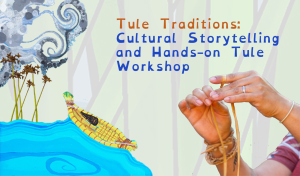
- Storytelling and Tule Workshop with Diana and Christina Almendariz: November 7 @ 4pm
“Tule has been my creative muse for 30 years. It still thrives in the rivers and marshes of California… Tule, along with cattail, is at the heart of the marsh economy… I am now in the process of working with ecologists and scientists to renew our understanding of how we can restore the wetlands. It is clear that cultural knowledge about tule is a critical part of the tools required in this endeavor.” - Diana Almendariz
What is the significance of this exhibit?
More than 95% of California’s wetlands have been destroyed over the last 200 years. This exhibit seeks to cultivate a new generation of stewards who will care for these important ecosystems, which include the wetlands supported by the City of Davis’ wastewater management program. By braiding Homeland Ecological Knowledge with an allied Western science perspective, and forging new traditions collaboratively, the exhibit offers multiple pathways for community involvement. Community members will be introduced to wetland stewardship from a Native perspective – what Diana Almendariz calls “the marsh economy,” and will learn how wetlands keep our soil and water clean, mitigate the impact of climate change, and nurture an intricate, biodiverse web of life.

Over the past five years, YoloSol, an arts, culture and ecology collective guided by Wintun homeland cultural practitioners and dedicated to restoring the ecological health of the Yolo bioregion has cultivated key just transition pathways including Tule Traditions, which uplifts the cultural and ecological importance of tule for Wintun/Maidu homelands. Once abundant in the Central Valley, tule and cattail marshes are now severely reduced, impacting both the environment and the cultures that thrive on it. Tule has long been cultivated and used by the Wintun peoples for shelter, clothing and comfort, and to make hunting and gathering tools. This material was gathered to teach the skills necessary for making a variety of baskets and objects for everyday use such as cordage, sleeping mats, dolls, and more. One of the most important uses of tule was as a construction material for base structures of homes, and for the creation of balsa boats which were a major mode of transportation.

As with all things Wintun, the cultural use of tule is deeply woven into its ecological significance. Among many benefits, tule marshes filter water and help regenerate depleted soils which have become impoverished across the state. They prevent soil erosion, and enable greater recharge of the aquifers. Tule marshes also sequester carbon, surpassing even tropical forests in this regard. Given their versatility and importance in natural-cultural relations, keeping tule traditions alive is of vital importance to the land and waterways they are nested in. While rooted in Wintun/Maidu ecology and culture, learning to care for tule has beneficial implications for all those who live alongside it.

Special thanks to Rachel Hartsough, John McNerney, Geoffrey and Meg Attardo, Nina Fontana, Sam King, Roshelle Carlson, Nicole Hebert, Stephanie Maroney, Erin Syoen, Erica Kohl-Arenas, Morgan Strong, Elizabeth Marley, James Williams, Nick Buxton, Sumaya Buxton, our friends at the Yolo Basin Foundation, the Tending and Gathering Garden at the Cache Creek Conservancy, and the Sacramento Native American Health Center (SNAHC) for their assistance with this exhibit.
Supported in part by the City of Davis Arts and Cultural Affairs Fund.
CREDITS
Featured Cultural Practitioners:
Diana Almendariz (tule arts, painting, photography), Christina Almendariz (tule arts, photography), Ooti Maxine (tule arts, painting, illustration, zines)
Featured Artists: Tanya Lieberman (shibori river), Ro Mottsmith (paper arts), azade Minasian (screen printing, illustrations), Anuj Vaidya (paper arts, sound installations, zines)
Art Production support: azade Minasian, Morgan Strong
Slice-of-the-Wetlands Feature: Geoffrey Attardo, Pranav Saharan (Lynbrook High School in San Jose, California),
West Yolo Wetlands Guide Producer: Juliette Beck
Event Leads: Juliette Beck and azade Minasian
Outreach Team: Christina Almendariz, Juliette Beck, azade Minasian, Anuj Vaidya
Exhibit Producer: Anuj Vaidya